Author Archives: José H. Leal

Shell of the Week: The Jupiter Dondice

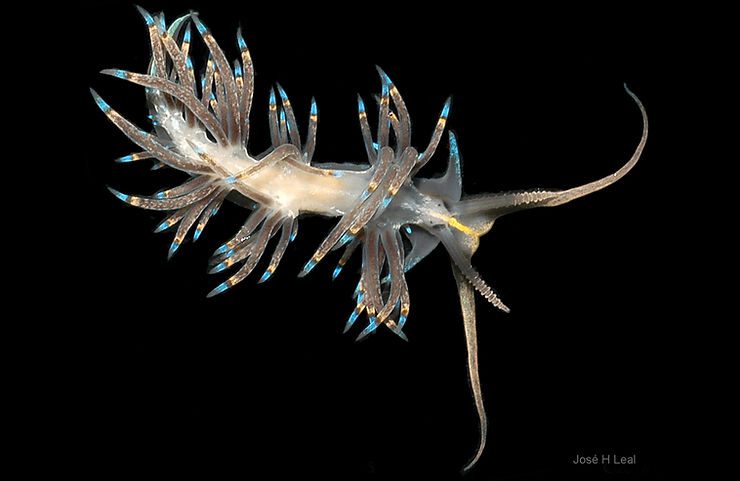
At 10 mm in length (a little less than 0.5 inch), the Jupiter Dondice, Dondice jupiteriensis García-Mendez, Padula, and Valdés, 2022, is one of the smallest (and most attractive) local species of nudibranchs (shell-less gastropods). The Jupiter Dondice has “moustache-like,” oral tentacles (left on image.) These tentacles can reach more than half the slug’s body length! The rhinophores, sensorial projections behind the oral tentacles, have irregular arrangements of rings on their upper half. The
Shell of the Week: The Smooth Flame Scallop

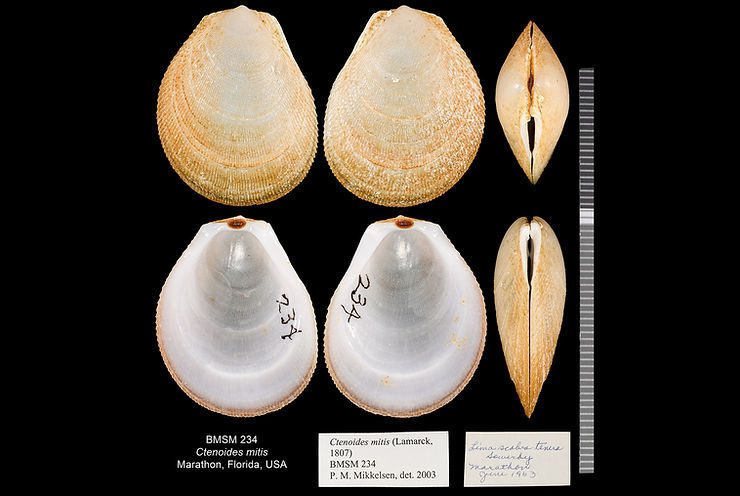
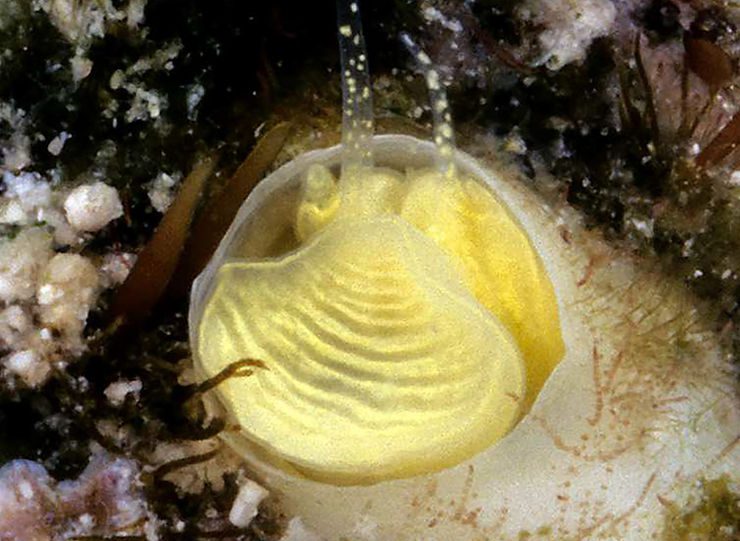
The Smooth Flame Scallop, Ctenoides mitis (Lamarck, 1807), is not a true scallop, but a member of the file clam family Limidae. It can can reach in excess of the 70 mm (about 2.76 inches). Its shell is relatively thin, bears a large number of fine radial ribs, and a thin brown periostracum. The Smooth Flame Scallop can be distinguished from the generally similar Rough File Clam, Ctenoides scaber, by the larger number of ribs. The species can be found off the coast of Florida, the Florida Keys, a

New Snail Named After Jimmy Buffet’s Song!

Very fittingly, a new marine snail was named this week after Jimmy Buffet’s best-known song, Margaritaville. Cayo margarita is a new species of worm snail from the Florida Keys reported by Rüdiger Bieler and collaborators that made the national news, including a nice article on CNN “Space + Science” online news. The bright lemon-yellow color of the snail’s “skin” provided the initial inspiration for the scientific name of the species. (And the genus name Cayo—low island, or key, in Spanish—honor

Green Mussels on Marco Island

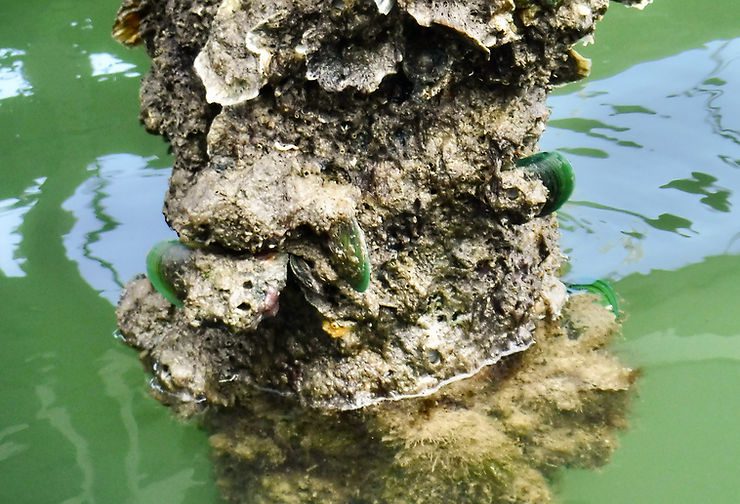
National Shell Museum collaborator Amy Tripp recently sent this great photo of a few Green Mussels, Perna viridis, on a dock piling at the south end of Marco Island. Young Green Mussels have a brilliant green color, and adult shells, reaching as much as 4 inches, are brownish with bright-green margins.The Green Mussel originates from the Indo-West Pacific region, but was introduced, probably via ship hulls and/or ballast water, to the western Atlantic Ocean and other coastal waters of the world’

Shell of the Week: The Dwarf Planaxis

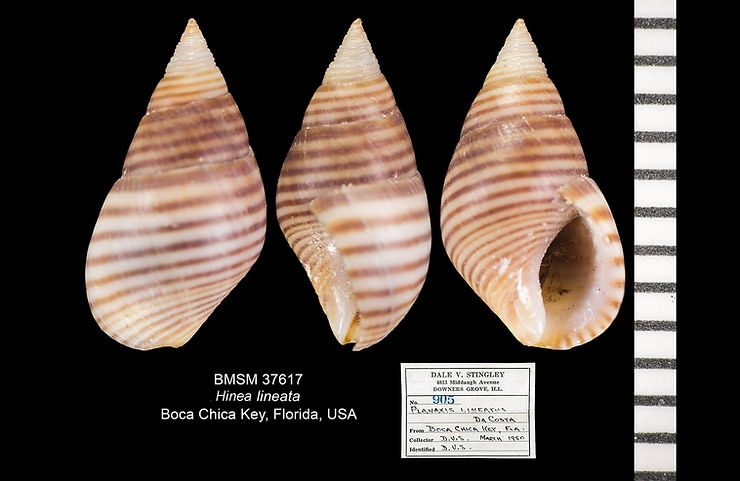
Hinea lineata is a small gastropod that reaches only about 10 mm (0.4 inch). The shell is smooth, and typically with narrow, brown spiral bands set against a cream-colored background. The species is found intertidally (between low and high tide lines) from East Florida, Bermuda, Bahamas, throughout the Caribbean south to Venezuela, and mid-Atlantic oceanic islands.

She’s Got Giant Squid Eyes!

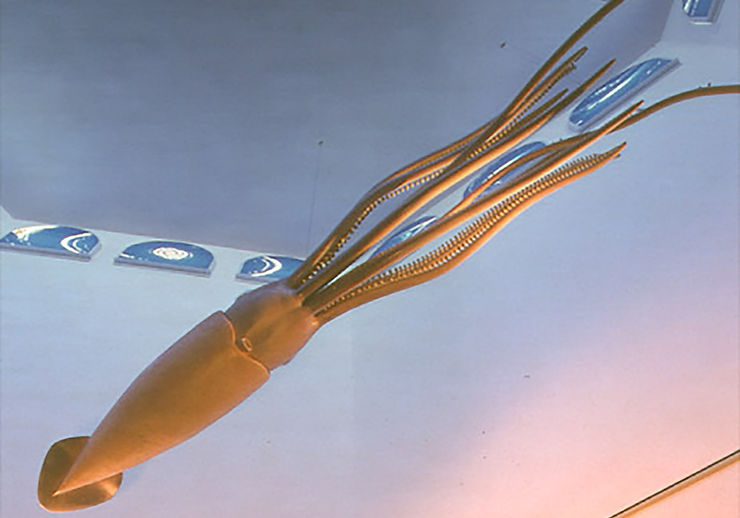
As part of the National Shell Museum renovation process, our Giant Squid model will be receiving a facelift. The squid was added to the Museum’s Great Hall of Shell in the late 1990s, there is inevitable wear and tear, and so much more has been learned about the species (Architeuthis dux) in the last two decades. The model will receive a new paint job, arms will be re-attached, and new, more realistic eyes will be added. Giant Squids may attain 40 feet in length, and their complex, vertebrate-li

Southwest Florida Shells

There are millions of mollusks living offshore along Southwest Florida’s shallow, 80-mile-wide continental shelf (the part of the continent under water). When cold winter winds from the north or northwest blow in the Gulf of Mexico, the water moves in directions that drive many mollusks (or empty shells) onto the shore. The effect is enhanced along barrier islands such as Sanibel, Captiva, Cayo Costa, and south to Fort Myers Beach, Keewaydin, Marco, Kice, and the Ten Thousand Islands. In the su

Shell of the Week: The Giant False Coquina

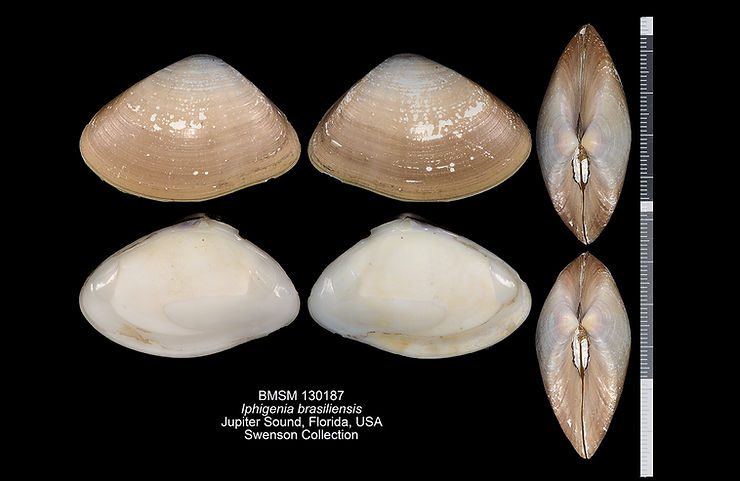
Iphigenia brasiliensis belongs to the coquina family, the Donacidae. Its shell reaches 66 mm (about 2.6 inches) and resembles a larger version of the local (in Florida) Variable Coquina, Donax variabilis. Its shell has a thin, smooth, light-brown periostracum (the outer layer). The wedge-shape of coquina shells help during quick burrowing in the sand. The species inhabits estuarine areas in Florida, teh Gulf of Mexico, and the Caribbean south to southern Brazil. #iphigeniabrasiliensis #iphigenia

Shell of the Week: The Little-ribbed Cardiomya

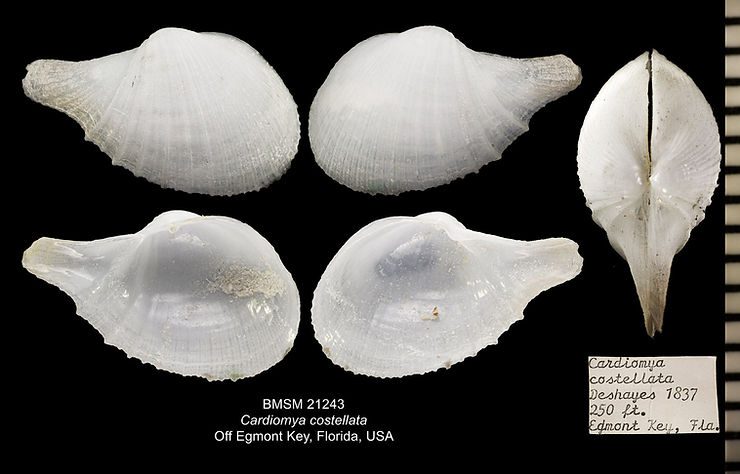
The bivalve Cardiomya costellata reaches only 11 mm (0.44 inch) and, as most members of the family Cuspidariidae do, has a shell sculpture of prominent radial (from the beak to the margin) ribs and a tube-like projection on the posterior end of the shell called a rostrum. The internal surface of the valves is glossy. Cuspidariid clams are carnivores and live buried, sticking their siphons through the rostrum out of the soft-sand or mud to detect and ingest prey (small worms, crustaceans, etc.) T

Cool 3D Models of Freshwater Mussels!

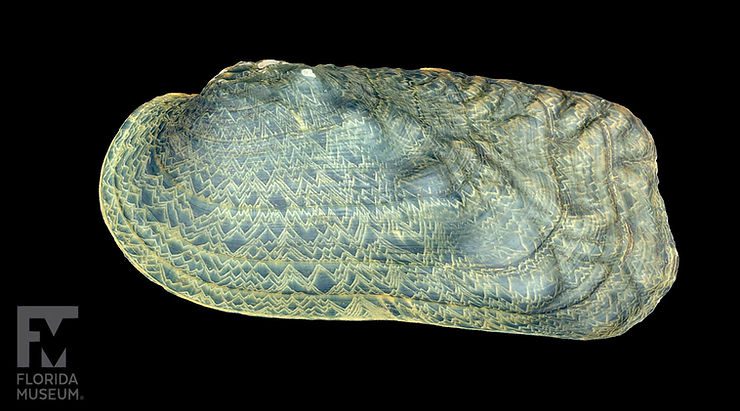
During the August episode of the National Shell Museum lecture series, Smithsonian’s Curator of Bivalves Dr John Pfeiffer presented (among several advances in the study of North American freshwater mussels) “Freshwater Mussels of America.” Dr Pfeiffer plays a major role in that great project, developed in association with his “alma mater,” the University of Florida/Florida Museum (Gainesville). “Freshwater Mussels of America” displays awesome 3D models of 100 species of freshwater bivalves from