Author Archives: José H. Leal

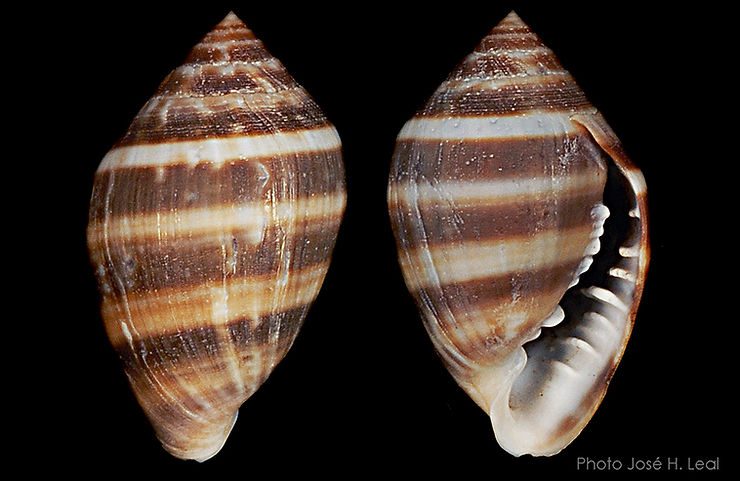
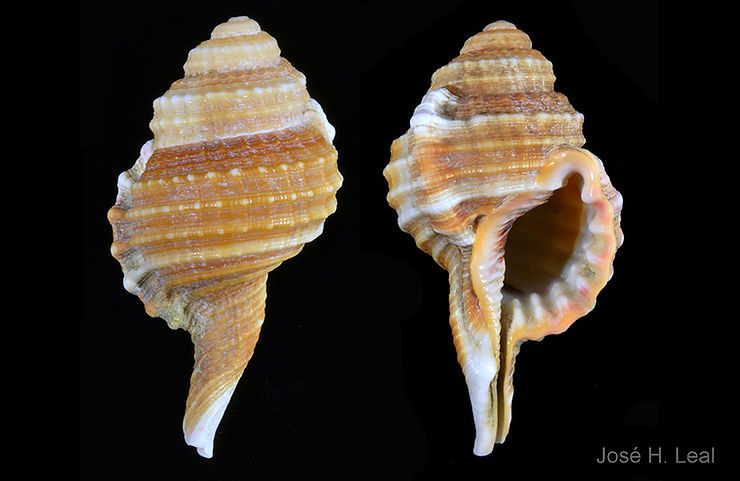
Shell of the Week: The Dog-head Triton

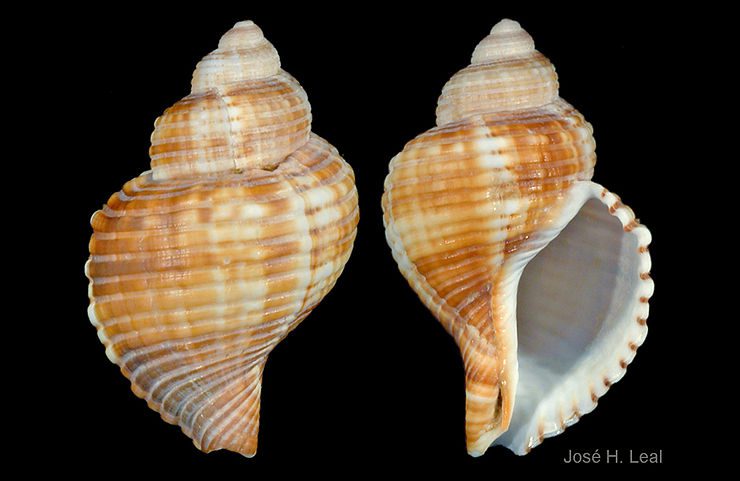
Ranularia cynocephala (Lamarck, 1816) has a sturdy shell that reaches 70 mm (about 2.8 inches). The shell has squarish whorls, a long siphonal canal that may be recurved, and may bear a varix, which denotes the occurrence of a growth stop). The shell sculpture consists of strong spiral cords crossed by weaker axial ribs. The outer lip of the shell aperture is garnished internally with 7 strong, white teeth. The shell color is usually golden-brown, often with a whitish spiral band near the middle
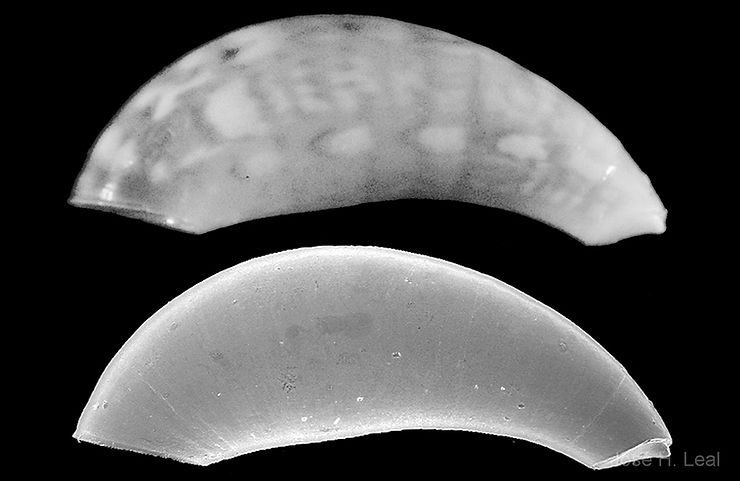
Shell of the Week: The Little Horn Caecum

Meioceras nitidum (Simpson, 1851) reaches only about 2.5 mm (0.1 inch). Caecum snails are mostly uncoiled, resembling little cylinder or tubes; they lose the coiled, early shell whorls at the end of the juvenile stage. The Little Horn Caecum has a tubular shell with bulbous mid-section, and very faint white and grayish markings set on a translucent background. Their shells can be found by sifting and sorting through the sands of Sanibel and Captiva and other parts of the western Atlantic. The im

Shell of the Week: The Girdled Triton

Linatella caudata (Gmelin, 1791) reaches 70 mm (about 2.75 inches), and has a shell sculptured with rounded spiral cords, sometimes with small knobs on the periphery (the angled part) of the last whorl. The color is light-brown, sometimes with broad spiral bands of lighter color. Tritons have extremely long pelagic (open-water) larval stages. These can be transported by ocean currents into areas farther away from where the mother tritons deposited their eggs. Girdled Tritons are not common in So

Shell of the Week: The Eastern Melampus

Melampus bidentatus Say, 1822 reaches 13 mm (about 0.5 inch), and has a solid, relatively thick shell with a smooth exterior. The visible internal shell surface (inside of the shell opening) shows a pattern of many tooth-like projections. The shell color consists of alternating bands of off-white and brown. Members of the melampus family Ellobiidae inhabit mangrove areas in quiet bays with sandy-mud bottoms, where they are found in the region immediately above the high tide line. They are adapte

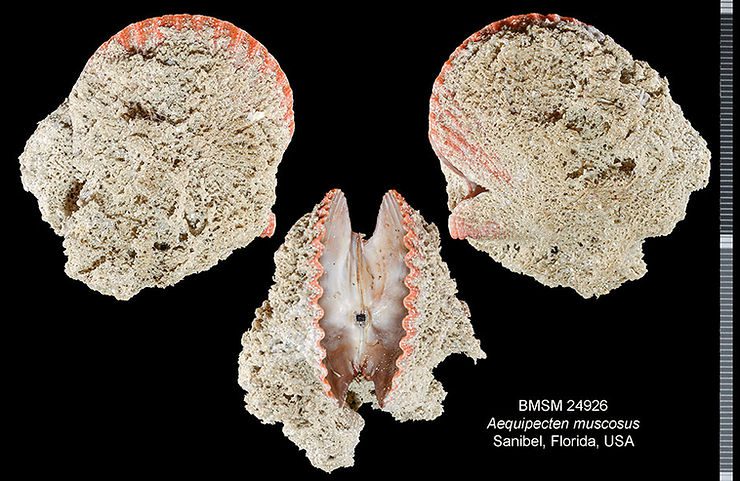
“Spongy” Rough Scallops

The Rough Scallop, Aequipecten muscosus (W. Wood, 1828), is one of three species of shallow-water scallops consistently found on the coast of Southwest Florida. Ten years ago, in February 2010, the beach at the east end of Sanibel Island was swarmed by large numbers of empty Rough Scallop shells. That in itself would be unusual, as the species is anything but common. But, in addition the large numbers present, both valves of those Rough Scallop shells were covered with sponge colonies. A little

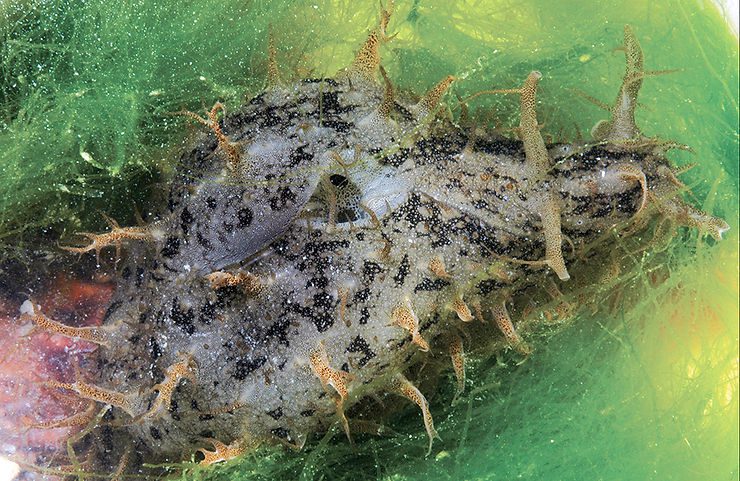
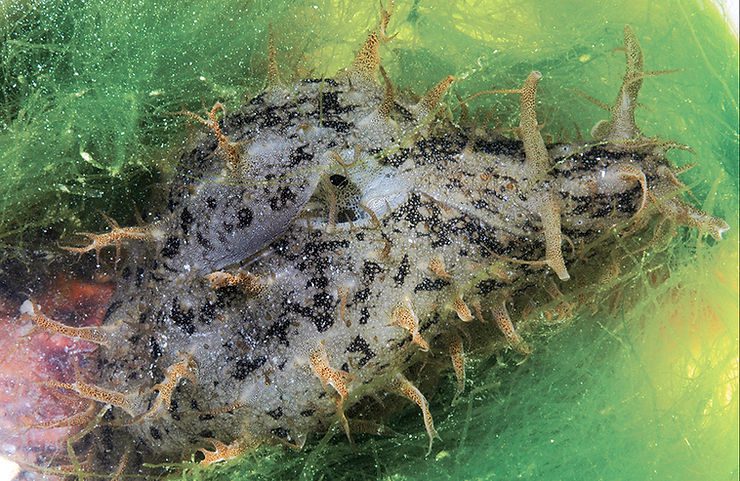
Shell of the Week: The Ragged Sea Hare

Bursatella leachii pleii (Rang, 1828) reaches 80 mm (3.15 inches) in parts of its geographic range in the western Atlantic. The vernacular (common) name derives from the presence of characteristic branched papillae, which impart a “disheveled” aspect to the slug. The species lacks the parapodia (wing-like expansions) that are typical of the larger sea hares in the genus Aplysia. It also completely lacks a shell in the adult stage (a shell is present in the larva and juveniles). Given the proper

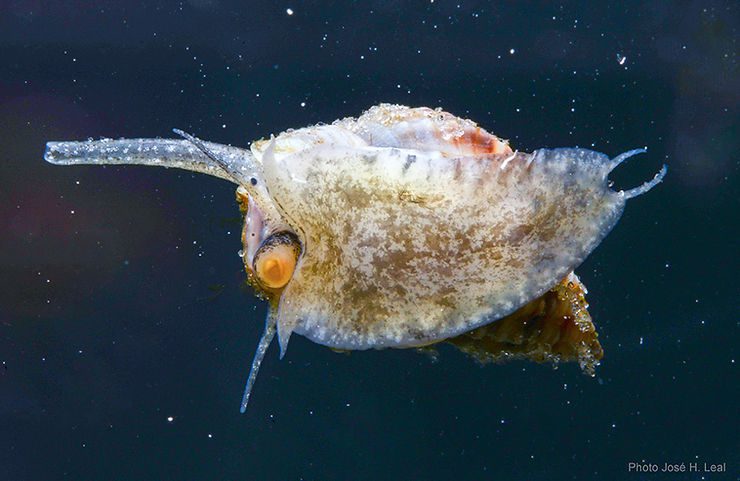
Busy, Busy, Bruised Nassa

With a shell reaching only 15 mm (about 0.6 inch), the Bruised Nassa, Phrontis vibex (Say, 1822), is one of most abundant snails in the back bays and sand and mud flats of Southwest Florida. Its shell has a sculpture of 7–12 axial ribs crossed by fine spiral lines of variable size. When it comes to color pattern, the Bruised Nassa is a very variable species, with assorted alternatives around the theme of specks and spots on a lighter background.The image above shows a live Bruised Nassa gliding

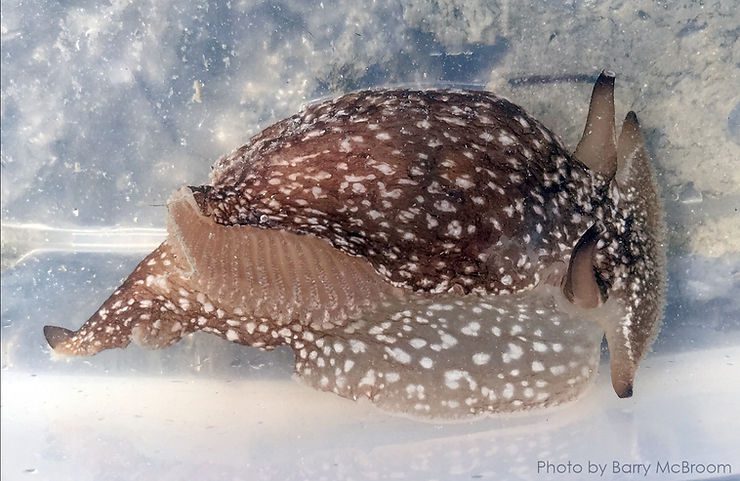
Shell of the Week: The Inconspicuous Side-gill Slug

The sea slug Pleurobranchaea inconspicua Bergh, 1897 measures up to 60 mm (about 2.4 inches). It typically has the foot with a wide frontal part (the veil) and covered with small papillae (projections). The gills, visible in the photo, are partially covered by the mantle, and the mantle forms a small siphon in the rear part of the animal. The photo was taken by Barry McBroom at Blind Pass, Sanibel, in January 2018.#inconspicuoussidegillslug #pleurobranchaeainconspicua #sanibel #blindpass

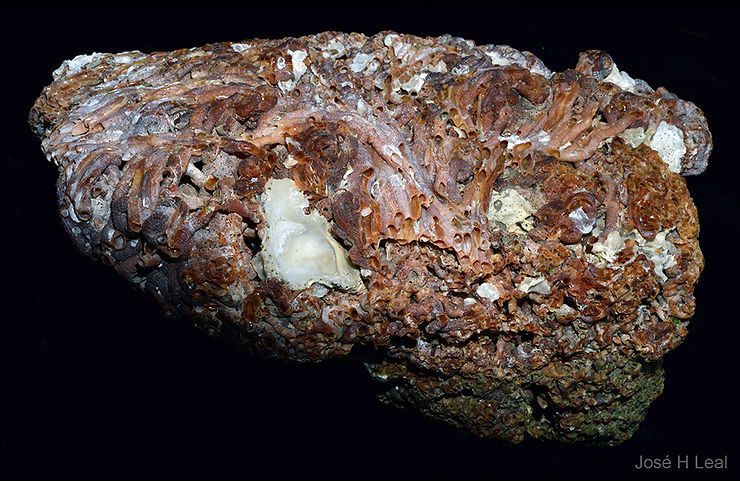
Shell of the Week: The Dark Worm Snail

The shells of Petaloconchus nigricans (Dall, 1884) are long, narrow, brown tubes sculpted with longitudinal ridges. As with other members of the family Vermetidae, the Dark Worm Snails live in agglomerations that form massive structures. The largest such cluster from Sanibel in the National Shell Museum Collection was found in September 2016 by Michael Reardon. That cluster (photo) measures 23 cm (about 9 inches), and the largest shell aperture diameter in this cluster measures about 3 mm (about

Sea Slug Highlight: The Ragged Sea Hare

Bursatella leachii pleii (Rang, 1828) reaches 80 mm (3.15 inches) in parts of its geographic range in the western Atlantic. The vernacular (common) name derives from the presence of characteristic branched papillae, which impart a “disheveled” aspect to the slug. The species lacks the parapodia (wing-like expansions) that are typical of the larger sea hares in the genus Aplysia. It also completely lacks a shell in the adult stage (a shell is present in the larva and juveniles).Given the proper c