Curator’s Corner

Museum, research, and collection updates from Dr. José H. Leal, plus Shell of the Week, which highlights a different species every other Friday. Most Shells of the Week are found in Southwest Florida.

Dr. José H. Leal serves as the Bailey-Matthews National Shell Museum & Aquarium’s Science Director and Curator. He received his Ph.D. in Marine Biology and Fisheries from the University of Miami and has served at the Museum since 1996.

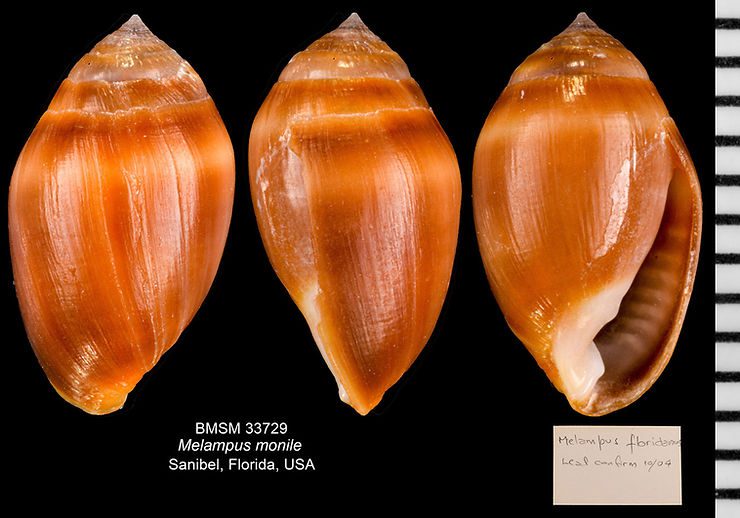
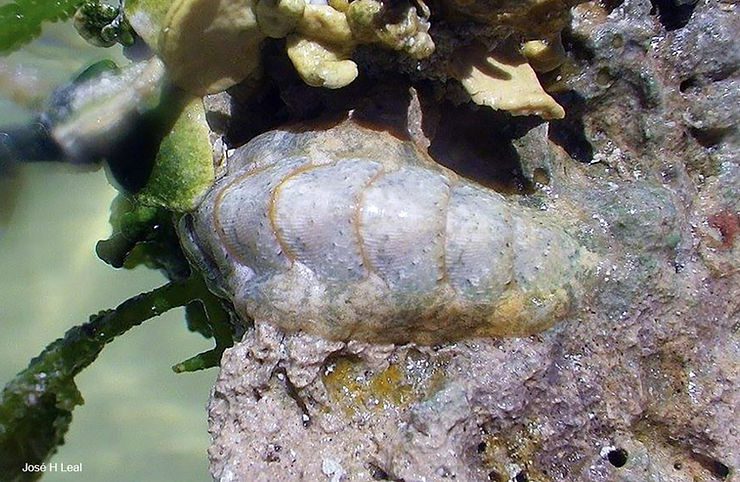
Shell of the Week: The Caribbean Melampus

Melampus monile (Bruguière, 1789) reaches about 16 mm in length. The shell is bullet-shaped, widest at posterior (upper) third. The spire is low. The aperture spans about ¾ of the shell length. The columella has two folds, one larger. The outer lip is smooth, but the internal surface of the aperture has about 12 raised, narrow spiral ridges. The color ranges from mahogany-brown to yellowish, with one broad, whitish spiral band below the suture of the last whorl. The shell interior is whitish. Th

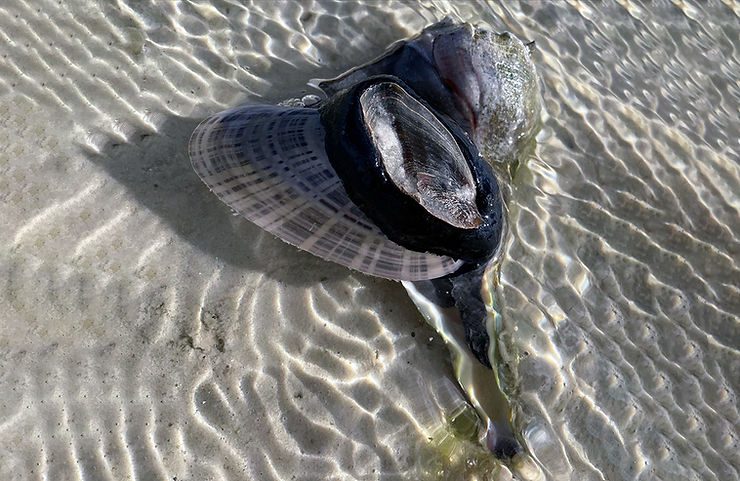
Meal Time!

During field work in Fort Myers a few weeks ago, National Shell Museum Marine Biologist Jorden Falker captured this remarkable image of a Lightning Whelk (Sinistrofulgur sinistrum) holding a Sunray Venus clam (Macrocallista nimbosa) in preparation for a meal. Lightning Whelks are known to use the edge of their aperture (the external lip) as a “clam knife” to pry open bivalves. To that end, they have to place the clam just so, which they do using their big foot to adjust the clam’s position. Ligh

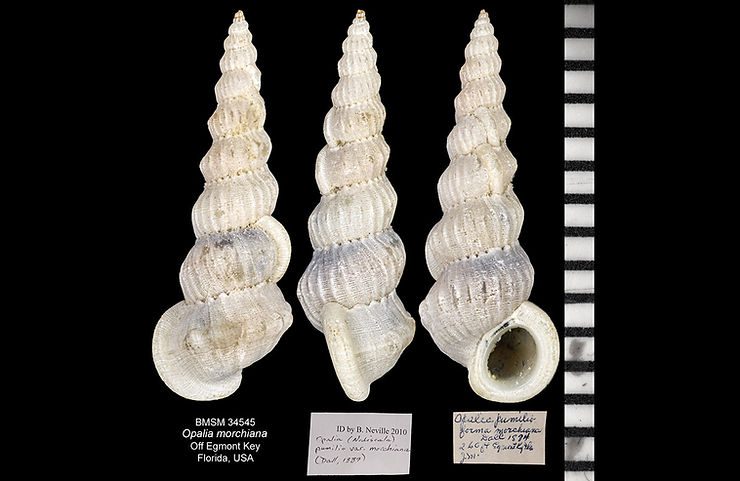
Shell of the Week: The Dimpled Wentletrap

Opalia morchiana (Dall, 1889) reaches about 12 mm in length. The species has a tall shell profile, with a variable number of wider axial ribs on each whorl and a large number of very small spiral cords crossed by finer axial ridges, which impart a pitted or dimpled aspect to the entire shell surface. The aperture is oval, uninterrupted, with a thick apertural lip. Former shell growth stops are indicated by a succession of irregularly spaced varices. Opalia morchiana is found between the depths o

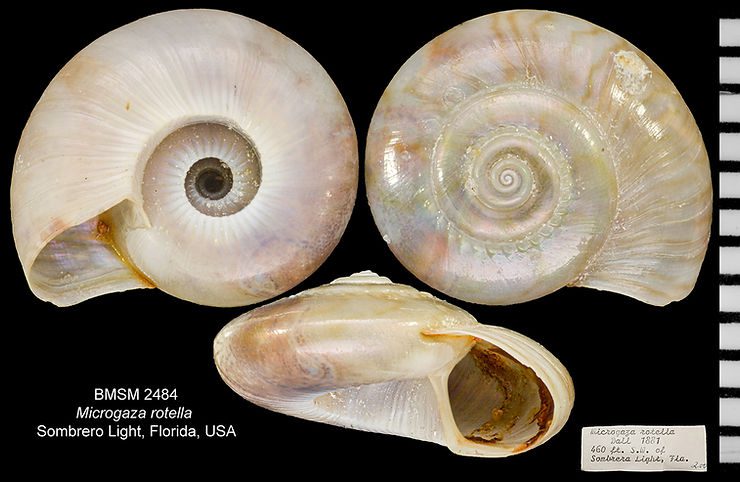
Shell of the Week: The Dwarf Gaza

Microgaza rotella (Dall, 1881) reaches about 8 mm in length. The species has a depressed (low-profile) shell, which is unusual for a member of the family Solariellidae. The spire is low, and the only sculptural feature present other than growth lines is a series of short raised ridge-like bumps just below the suture (the line between two whorls.) The base has strong axial raised ridges that are stronger toward the deep umbilicus. The shell has a cream color with faint salmon-orange, irregular ba

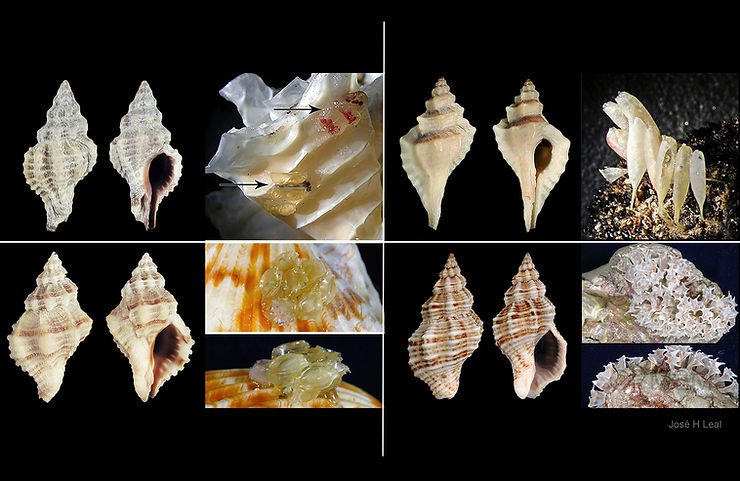
Three Drills and One Cantharus

Some of the shells you’ll find on the beaches of Sanibel and Captiva are relatively similar. Take, for instances, three local species of drills and one drill-look-alike. The image shows photos of the shells and egg capsules of, in clockwise direction from bottom left, the Gulf Oyster Drill (Vokesinotus perrugatus), the Mauve-mouth Drill (Calotrophon ostrearum), the Sharp-ribbed Drill (Eupleura sulcidentata), all members of the family Muricidae, and the non-drilling Ribbed Cantharus (Hesperistern

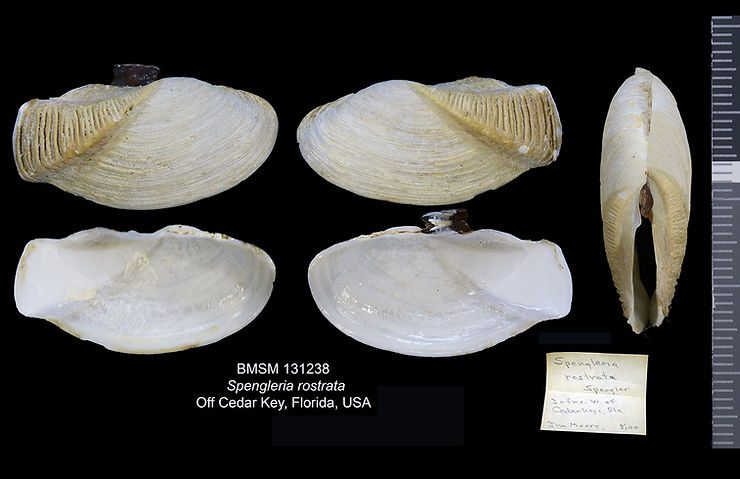
Shell of the Week: The Rostrate Rocellaria

Spengleria rostrata (Spengler, 1783) reaches about 30 mm in length. Its shell is relatively elongate, with a triangular raised area spanning from the beak to the posterior region. That triangular area is festooned with transversal ridges. The shell color is white, with a yellowish periostracum. Rocellarias bore into empty shells and corals, and their burrows are distinguished by typical figure-eight-shaped holes.

Shell of the Week: The Keys Top Snail

Calliostoma adelae Schwengel, 1951 reaches about 40 mm in height, and has a moderately wide spire angle. The shell sculpture consists of finely beaded spiral cords that alternate with narrower threads in the last shell whorls. There are about 2–3 cords with larger, lighter-colored beads above the suture (the boundary between two whorls), the umbilicus is moderately large, umbilicus wall cream-colored, bordered by one larger-beaded cord. The shell color is yellowish-brown, with a pattern of diffu

That Snail is Back in Florida

The Giant African Snail, Lissachatina fulica, has returned for another “visit” to the Sunshine State. The species is native to East Africa, but has been introduced to many other parts of the world via the pet trade, as a food resource, and by accidental introduction, most likely with ornamental plants. Authorities believe that the current invasion, first detected in New Port Richey, Pasco County, results from the illegal pet trade. Giant African Snails first invaded the Miami area in 1966, and w

Shell of the Week: The Gulfstream Top Snail

Calliostoma scalenum Quinn, 1992 reaches about 40 mm in height, and has a moderately narrow spire angle. The shell sculpture consists of finely beaded spiral cords that are intercalated with alternating narrower threads in the last shell whorls. There is a relatively large number of cords on the shell base, the umbilicus is relatively small, umbilicus wall white, bordered by a couple of larger beaded cords. The shell color is light-brown, with a pattern of whitish crescent-shaped spots on the wh

Shell of the Week: The Spathate Scallop

Cryptopecten phrygium (Dall, 1886) lives off the Eastern Seaboard of the US, from Massachusetts to Florida, from 42°N to 18°N, at depths between 90 to 190 m (300 to 620 ft). Its distribution range includes the Gulf of Mexico, where it is relatively common at those depths. The shell color is very variable in this species, including variations of light-gray and magenta patterns. The sculpture consists of 14–20 radial ribs, which are in turn superimposed by narrower riblets, which are also present