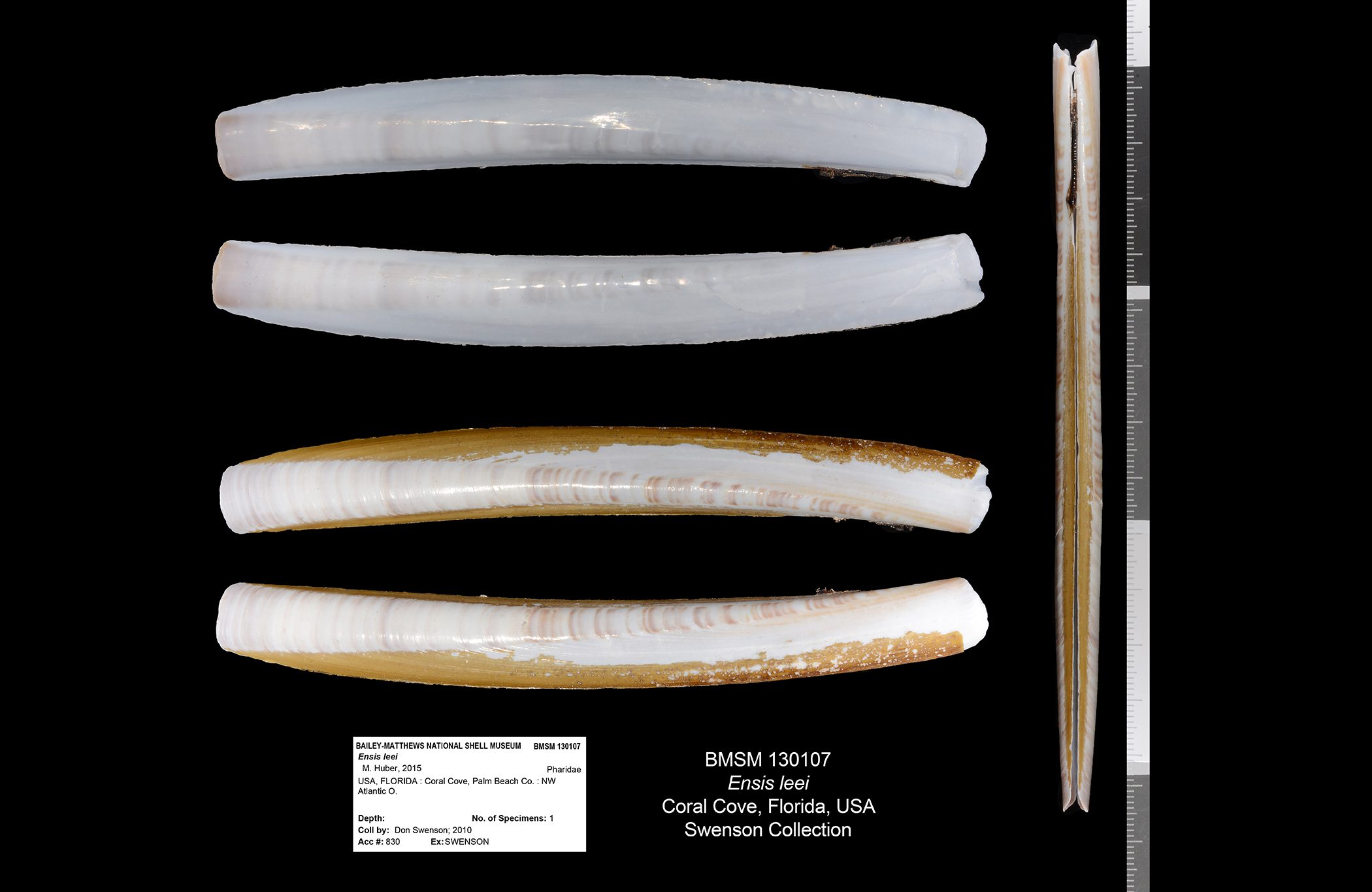
Ensis leei is a long, narrow, slightly curved bivalve that resembles old-school straight-edge razors. Their shells can reach 25 cm (approximately 10 inches) in length. Atlantic Jackknife Clams burrow into the mud or sandy-mud of the quiet bays where they live. The species has a broad native distribution along the coasts of the northwestern Atlantic Ocean, from Canada to Florida, but has also been introduced to the coasts of Europe, including the North Sea and the United Kingdom. The Atlantic Jackknife Clam is prized as a delicacy in the northern parts of its distribution, particularly in New England, Canada, and Europe.
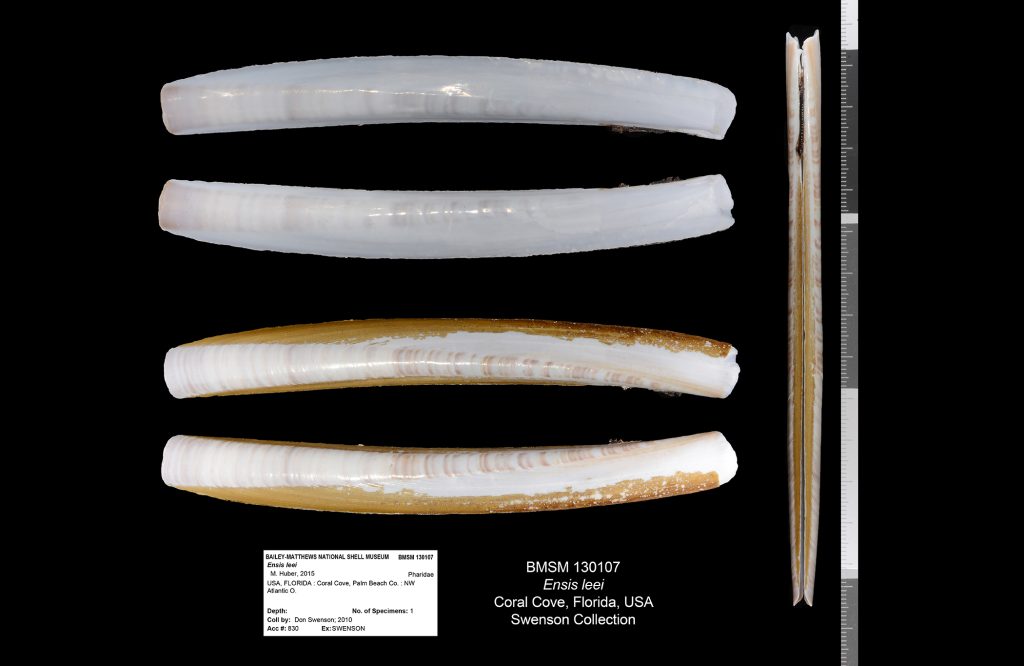
Atlantic Jackknife Clams were formerly known as Ensis directus but, in his 2009 book on northeastern Florida shells, the late citizen scientist (and our Museum supporter) Dr Harry G. Lee indicated that the name Ensis directus was applied originally to a Pliocene fossil species and not to the living one. In 2015, following Dr Lee’s 2009 observation, Markus Huber formally named and described the species after him.
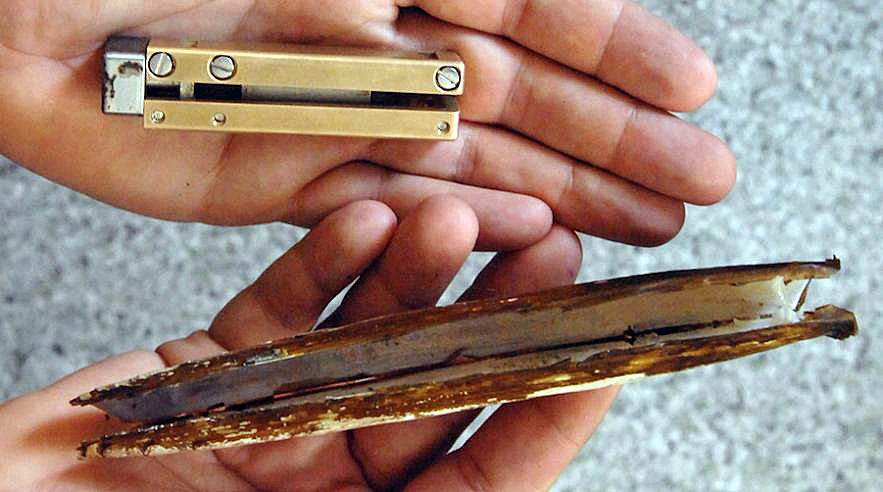
In 2014, MIT engineers drew inspiration from the Atlantic Jackknife Clam’s burrowing behavior and complex motions to design an underwater burrowing tool, the RoboClam, now used in ocean engineering applications. Read more about their device here. And learn more about the collection specimen illustrated above here.